
How Many Headshots Does an Actor Need?
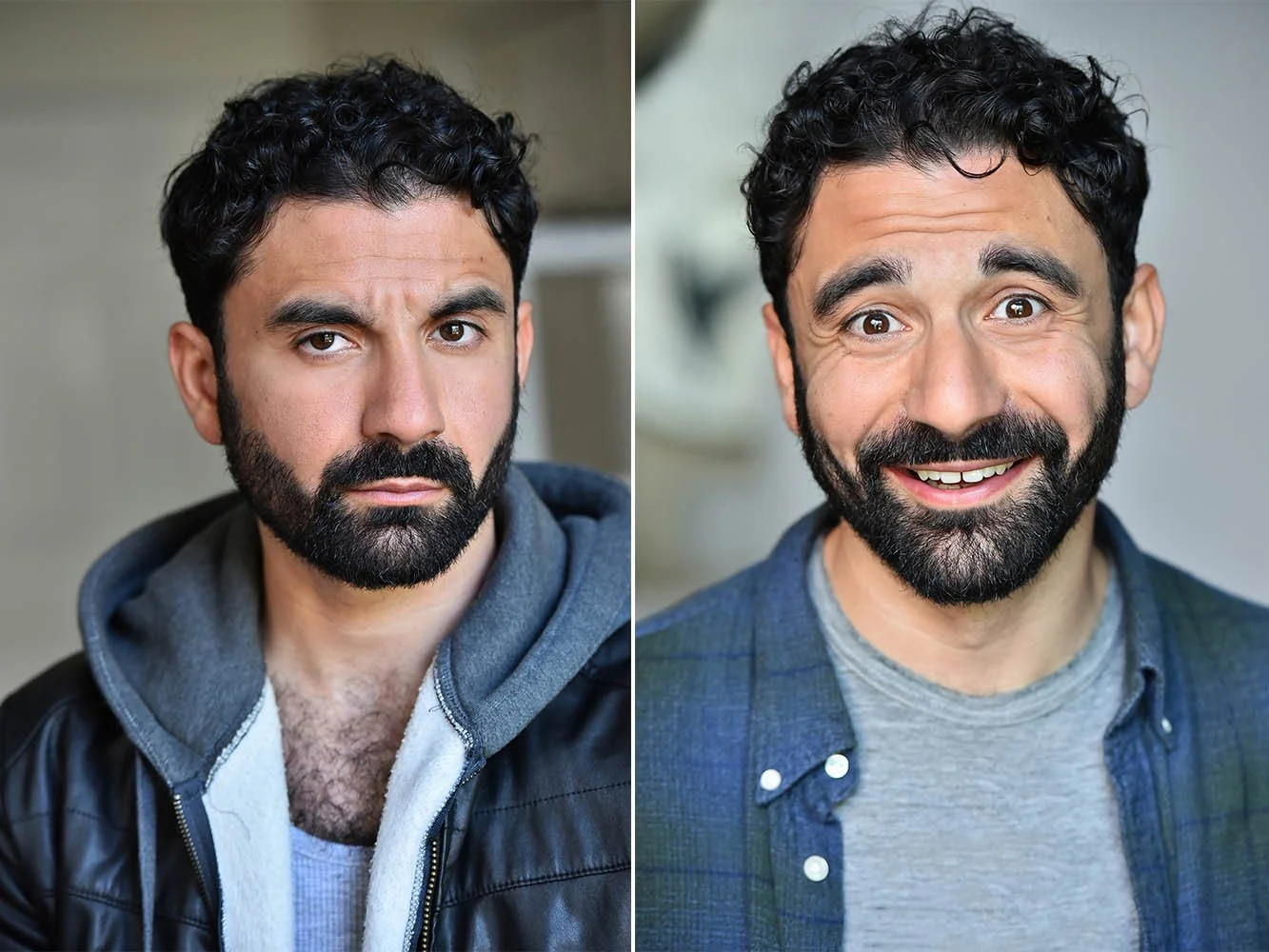
The honest answer depends on where you are in your career and what you are actually trying to do with the images. There is no fixed number of headshots an actor needs. An actor just starting out needs something different than an actor who has been auditioning for years and has real feedback to work from.
What matters more than the number is whether each headshot has a clear reason to be there. Two genuinely different looks can tell casting more than five images that are essentially saying the same thing.
Starting Out: Two Strong Actor Headshot Looks
If you are early in your career and planning to pursue both commercial and theatrical work, two looks is usually enough to start. One should be warm and approachable, built for commercial and comedic submissions. The other should be grounded and character specific, built for theatrical, film, and television. Together they give you two useful starting points without asking you to guess at range you have not tested yet. I go into more depth on what separates these categories, with examples, in Actor Headshot Examples: What Different Looks Communicate.
Two looks at this stage is not a limitation. It is a starting point. You do not yet have enough audition history to know where you are strongest, and shooting more than two looks before you have that information usually means guessing.
When to Add a Third Headshot Look
After you have been auditioning for a while, the calculation changes. Your headshots should start reflecting what you have actually learned, not just what you think you can play. There is a real difference between what you can play and what you are getting called in for, and that gap is often exactly where a new headshot earns its place.
I have seen this play out clearly. I once photographed a well known actress whose roles tend to run buttoned up and controlled, always by the book. I expected someone similar to walk into the studio. She was the opposite: relaxed, funny, more rock and roll than her characters would suggest. She told me that was simply how casting saw her, so she leaned into it. She did not fight the read. She used it.
If you do not already know how the industry sees you, there is a simple exercise that can give you some insight: ask five to ten people, some who know you well and some who do not, to give you a handful of adjectives that describe you. Look for where the answers overlap. I walk through this in more detail in How to Identify Your Casting Type for Actor Headshots. The short version is that your type is often less about how you see yourself and more about how you read to a room that does not know you yet.
Sometimes this shift isn't even intentional. I have a client who shaved his head without any strategic plan behind it. Afterward, he started getting called in for a type of role he had rarely been considered for before. He did not plan that shift, but it is a useful reminder that a real change in your look can change what casting notices, not just how you look in the photo. Your agent is a good resource for finding these gaps intentionally rather than by accident: what roles are showing up often in current breakdowns, and where does your current portfolio have a hole relative to that. I go deeper into that conversation in What to Ask Your Agent Before Getting New Actor Headshots.
A Framework for Actor Headshot Range: Class Level
When actors ask me how I would split three looks, I often think in terms of class level: working class, middle class, and wealthy. It is a tool, not a formula, and it only works alongside a real answer to what you can convincingly play. But it gives you a concrete way to organize range instead of reaching for vague ideas about "type."
Class level on its own does not tell you who the character is. A wealthy character is not automatically the stiff, buttoned up type. It could just as easily be someone who grew up with money and is actively rebelling against it, which reads completely differently on camera than someone rebelling against neglect or hardship. The class level sets the world. What you bring to it is the character.
One actor I worked with built her range almost entirely around this idea. In one look, wardrobe and makeup pushed her toward something rough and hard living: a tough, weathered woman the town both respected and feared. In another, she became a warm, wise grandmother figure, the kind of woman a town turns to for comfort and would not want to cross if you hurt someone she loves. In a third, she was polished and untouchable, the wealthy woman who owns half the town. Three completely different characters, but the throughline across all of them was the same: authority, confidence, and presence. That consistency is what made each look believable rather than costume.
Why Three Headshot Looks Are Often Enough
For most actors, three looks cover a useful amount of territory. Beyond that, each additional look needs a clear reason to exist, unless you are a genuine character actor with a wide, specific range that actually calls for more variety.
The standard I use for whether a look earns its place is simple: does it tell me something the other looks do not. If you can't identify a specific casting need a new look is meant to address, you probably don't need it yet. This is where I see the most common mistake on casting profiles: a set of ten images that all read the same. The wardrobe changes, the light shifts slightly, but the expression and energy underneath stay identical. Instead of showing range, it dilutes the actor's presence and can read as unintentional. A tighter set of two or three looks that are genuinely different is usually more useful than a long set that only appears different at a glance.
So, How Many Headshots Does an Actor Need?
There is no universal number. Start with two looks that represent what you can convincingly play. Once you have real audition feedback, let that feedback guide whether a third look is worth adding, and use it to sharpen the two you already have. Whatever you shoot, make sure every image is earning its place by showing something the others do not.
If you are not sure where you currently stand, that is exactly the kind of conversation worth having before your next session, not after it.