
How to Evaluate Your Commercial Headshots
Commercial headshots are usually associated with warmth: a bright smile, open energy, someone you'd trust to tell you about a product. Plenty of strong commercial headshots look exactly like that. But warmth isn't a requirement, and a smile on its own doesn't make a photo work.
When I review a session, I'm not asking "is this commercial enough?" I'm asking whether the photo delivers what it was built to convey, and whether I believe it. Every photo here comes from my own sessions, and most of the comparisons show the same actor in two strong frames. Neither one is wrong. They just say different things.
For the basics, see Commercial vs. Theatrical Headshots and Actor Headshot Examples. This guide picks up where those leave off: looking at your own photos and deciding which one is doing the job. When I'm narrowing down commercial headshots, I come back to three things: what the photo is meant to communicate, whether the expression delivers it, and how well the photo is executed.
Start With What the Photo Is For
I look at photos differently depending on why I'm looking. Sometimes I'm matching a photo to a product idea. Sometimes I'm looking at a photo and asking what the person in it could sell. For my own portfolio, I'm mostly asking whether it's an accurate, authentic representation of the person.
For an actor choosing a commercial headshot, the most useful of those is usually the second: what could this photo sell?
One way to think about it is who the photo invites in. Picture two hypothetical commercials. One is for an exclusive luxury brand. It might feel grounded, reserved, and a little intimate: warm smiles, subtle glances, almost a private invitation. The other is for an amusement park or a big-box store. It might feel bright, outgoing, and full of energy, built to welcome as many people as possible.
Neither one is more commercial than the other, and these are illustrations, not categories. A commercial headshot can speak to very different audiences. What matters is whether yours communicates what you want it to.
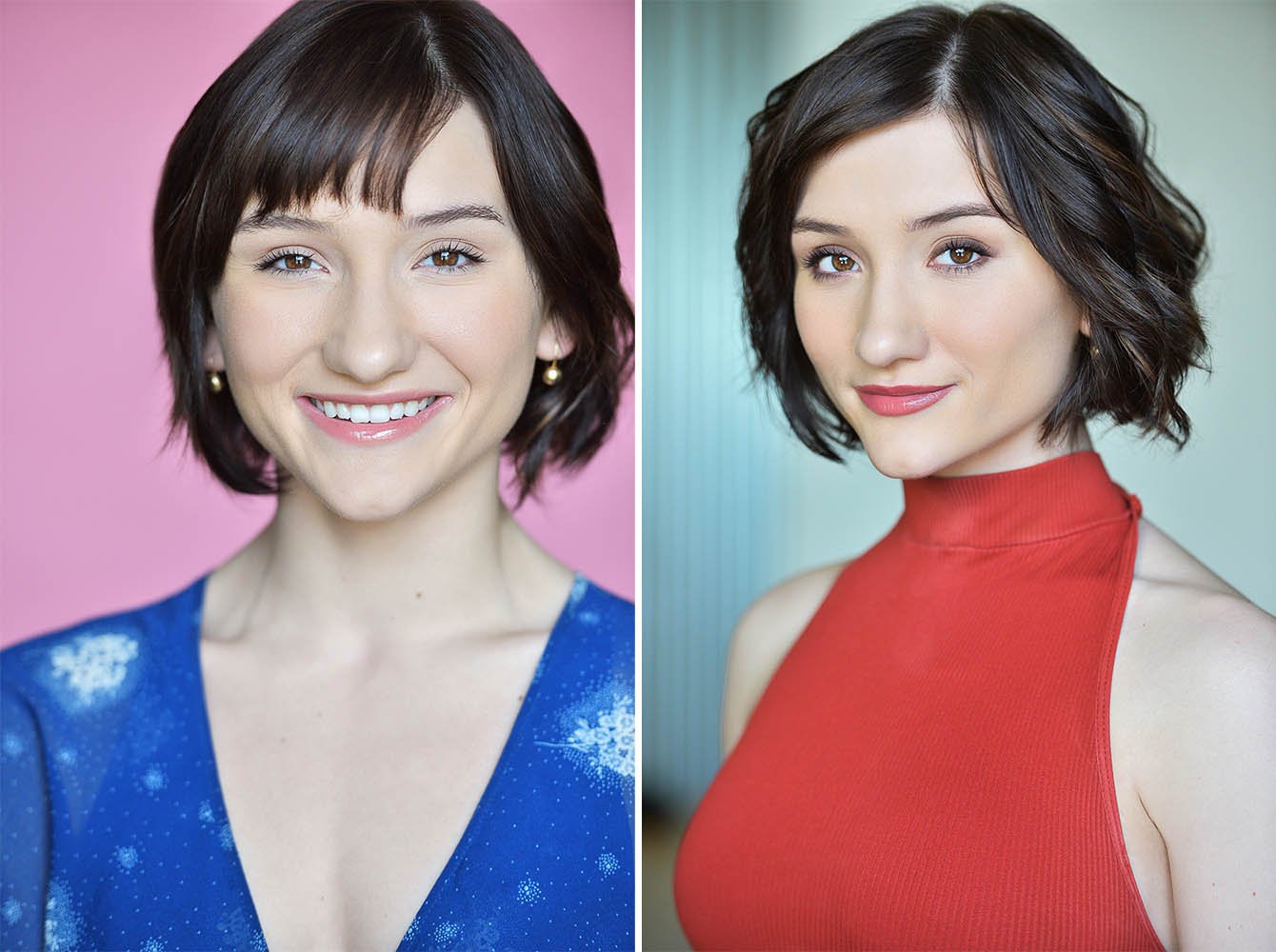
This pair changes the whole look, not just the expression: wardrobe and background shift too. To me, the bright color and full smile give the first a more outgoing energy, while the closed smile and tilt make the second feel more personal. Both are strong. Which one is "better" depends on where she wants to point her commercial work.
Look at the Eyes First
In my opinion, the eyes are where the story sits. Everything else in an expression branches out from there, so the eyes are the first place I look. They're also a good place to start when you're reviewing your own photos.
A lot of what I notice is felt before I can explain it. During a session, I'm coaching toward a specific feeling, and sometimes that feeling calls for the eyes and mouth to say slightly different things. When that's on purpose and it lands, it's exactly what I'm looking for. When it isn't, and the eyes and mouth just aren't agreeing, the expression feels off to me. Sometimes an actor gives me exactly the smile we talked about, but the eyes haven't quite arrived at the same place. That's when I keep working rather than settle for the frame.
A few questions worth asking of your own photos:
Do the eyes feel engaged, or disconnected?
Does it feel like you're interacting with someone, whether that's the camera itself or someone off camera?
Does the smile feel bigger than what's happening behind the eyes?
That last one is the one I watch most. It's an issue I run into: the smile outpaces what's happening behind the eyes, and to me the expression stops feeling convincing.
If the goal is a confident shot, I look for confidence in the eyes first. Posture and everything else come after that.
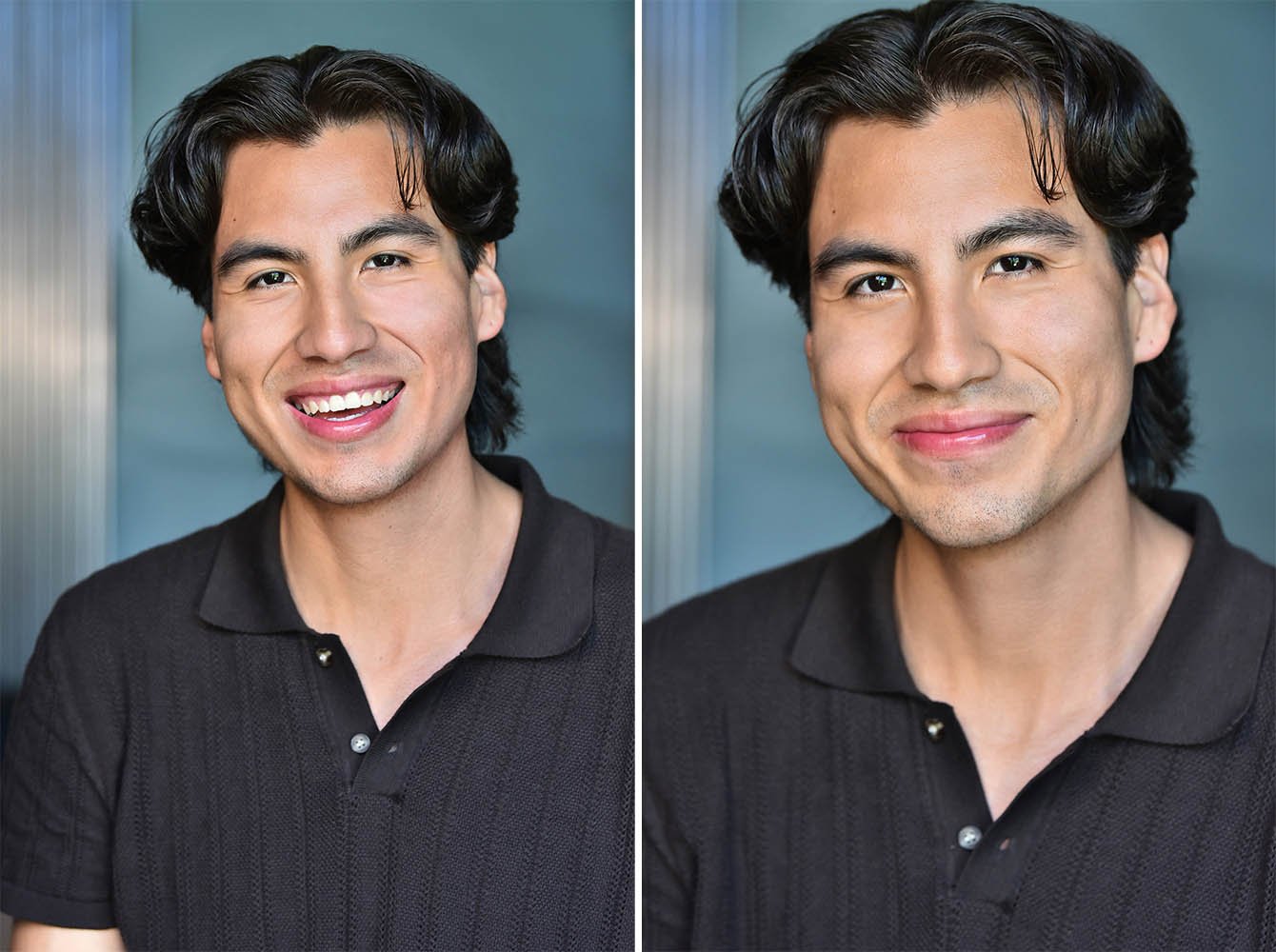
Same actor, same setup, same light. In the first frame, the smile is wide and open. In the second, it closes. To me, the first reads as an invitation and the second as something more private. Neither is wrong; they land differently.
When the Mismatch Is Intentional
That same gap between the eyes and the mouth can also be a tool. When an actor wants to show nervousness, I'll sometimes play with it on purpose: a big smile with eyes that don't quite keep up. It works the other way, too. Eyes that carry a little more than the smile might read as a happy secret, or a bit of mischief. An actor who often plays anxious characters might want a happy mouth with worried eyes, and comedy often plays with this kind of contrast.
These are examples, not a complete list, and context changes all of them. Any of them can work, as long as it's by design and it still says something useful about the actor.
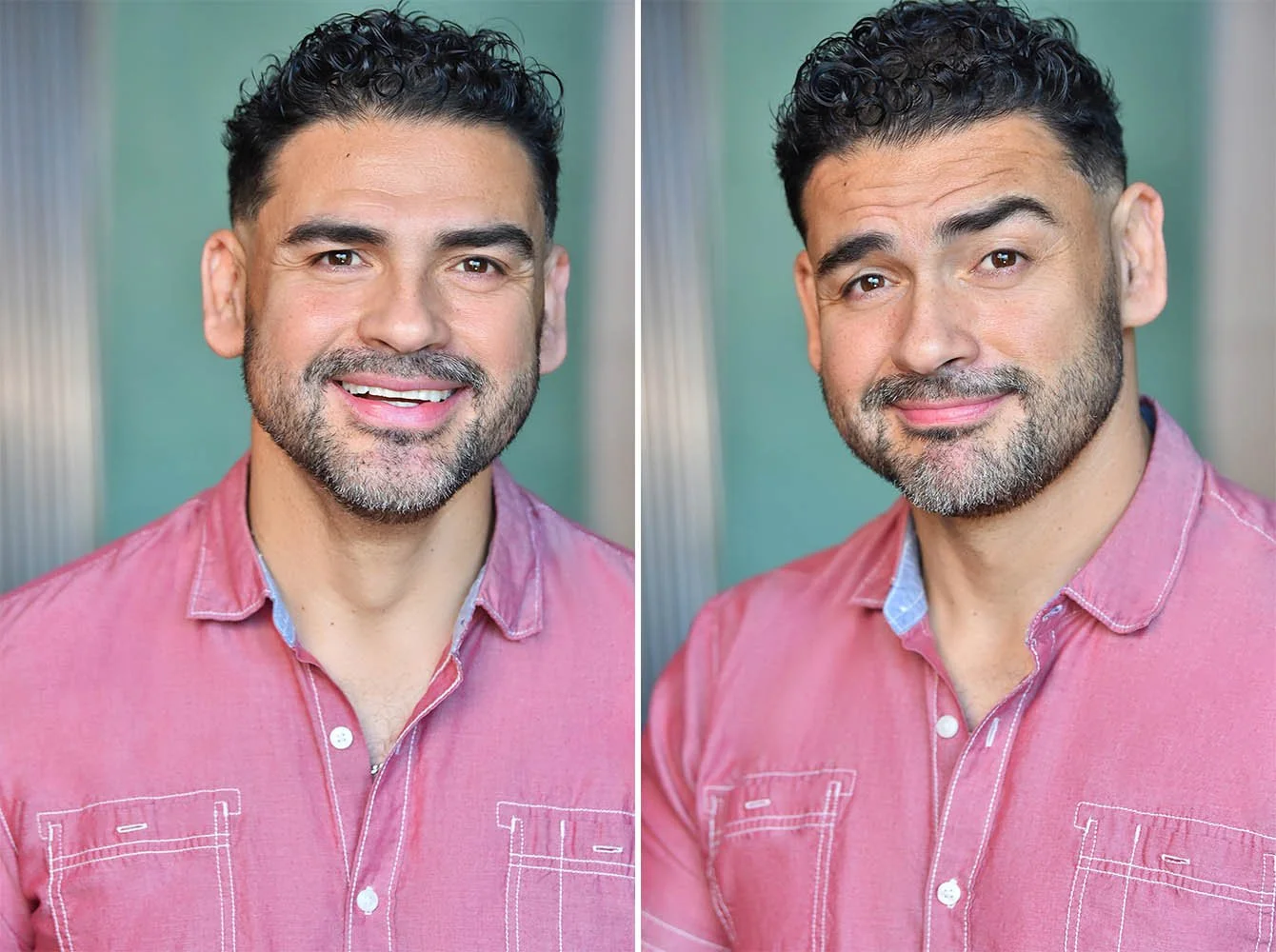
In the first frame, everything opens up together. In the second, the smile stays closed while the brow and eyes stay active. Same person, two very different reads. I'd rather not tell you what the second one says. Decide for yourself, because that's exactly the exercise to try with your own photos.
Can a Serious or Edgy Headshot Work for Commercials?
Yes, sometimes. These shots tend to work through the overall feeling of the image rather than a big expression. The smile may be cooler, more reserved, or not there at all.
None of this makes a serious frame more sophisticated than a smiling one. A big, genuine laugh can be exactly the right photo. The question is what the photo communicates and whether that fits where you're headed.
No one owns edge, and it means different things for different people. When the expression or styling doesn't feel convincing for that particular actor, the photo can start to look more like a costume than a believable representation, and that's often easier to see when it sits among other headshots.
I learned this from both sides. Early in my own acting and modeling days, I was on a great photo shoot. Between setups, I was hanging out by the fire escape, and the photographer liked the vibe and came over to snap a shot of the scene. That impulsive frame turned into a serious, shadowy photo of me that suited the younger, edgier New York look that was everywhere at the time. My agent loved it. I booked considerable commercial work while using that headshot. I can't say the photograph was responsible for those bookings, but the experience showed me that a commercial headshot doesn't always need to follow the familiar smiling, approachable formula.
Then there's the other side. Newsflash: I'm not a tough guy. On one job, they decided on set to take my character in a tougher, more street-smart direction. Nothing anyone tried made me look tough enough, so they eased it back a little. A photograph could give me the cool look of the moment. It couldn't make me look tough.
Playing against type is real, and plenty of actors do it well. Clearly, I did not. It helps to remember that type here means how you come across when you're performing, not necessarily how you are in daily life. Those can be different. A very outgoing person can read reserved and thoughtful on camera, and a quieter person can reveal an edge on camera that you'd never see over coffee. Sometimes a session brings out a quality like that, and it can be worth building on. The key is knowing when you're playing against type, so you're choosing it rather than stumbling into it. Be honest with yourself, and ask your reps or people you trust what they see. If you're still working out what you naturally project, How to Determine Your Type is a good place to start.
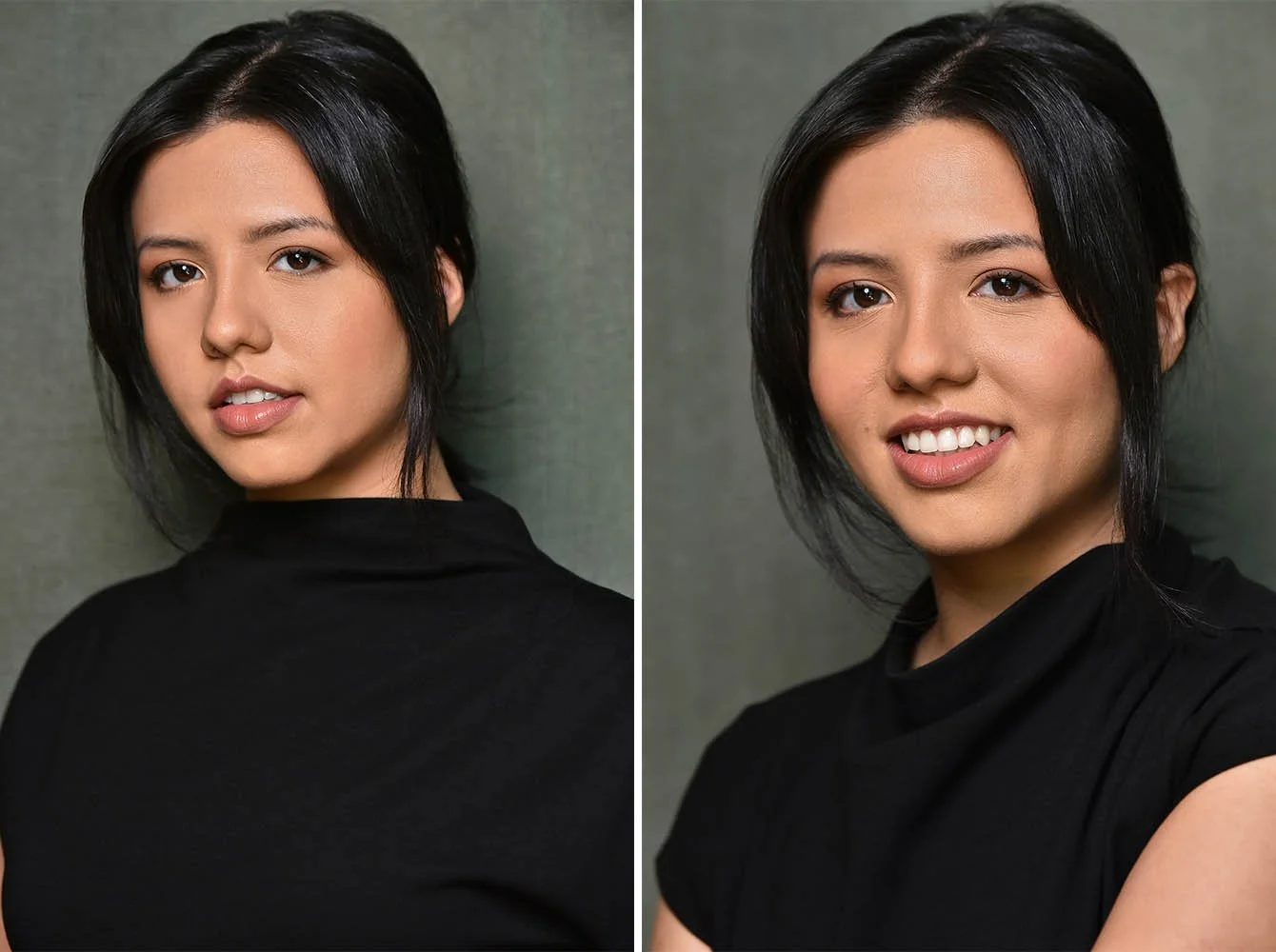
Same actor, same top, same background. The main change is the expression, along with a slight shift in head angle. The first frame is restrained, with a steady gaze and no smile, and to me it still reads as polished and confident. The second is warm and direct. If she wanted to lean toward a more reserved, upscale direction, the first frame might be the stronger choice. For broad, friendly work, the second probably is.
Eye Contact or Off Camera?
Direct eye contact is the familiar approach, and for good reason: it connects the actor with the viewer. An off-camera look works differently. It lets the viewer connect with the actor in the context of the world the actor is experiencing.
I still consider eye contact important, but it isn't an absolute rule. When an off-camera shot really sells an idea, it can be folded into a set, and I've seen agents do exactly that. Looking away isn't the point. What the photo communicates is.
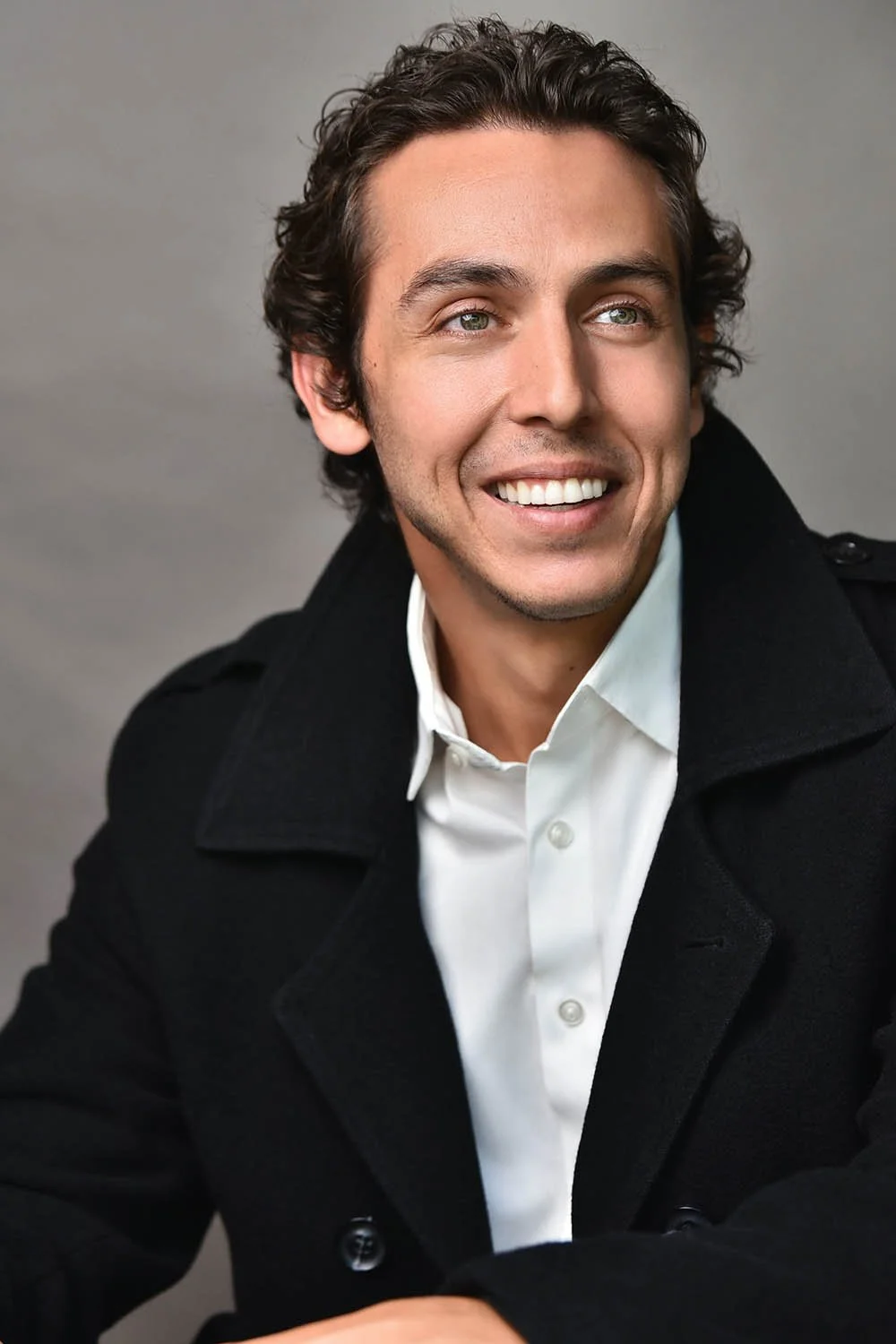
He's looking away, as if reacting to someone just outside the frame, and the smile still reaches his eyes. Instead of speaking to the viewer, the photo brings them into his moment.
Choosing Between Two Strong Commercial Headshots
Having several good frames is a good problem, and it can still be a hard one. I see near-identical frames all the time when I'm going through a session, and narrowing them down is part of my job before anything goes to the actor. The process I use translates well to actors choosing their own. Whether the frames are nearly identical or point in different directions, I work through three questions:
Purpose: Which photo better supports what you're trying to communicate?
Expression: Which one communicates that quality more convincingly? Sometimes the difference is small, like a smile that's slightly too big in one frame.
Execution: If both land the feeling equally, which has the stronger technical and visual execution?
That third question is where technical quality comes in. Focus, light, and retouching matter, and a technically beautiful photo can absolutely be the right one. But given the choice, I'll lean toward a frame where the person is showing something true over a technically stunning one where they seem disconnected. The best case is both.
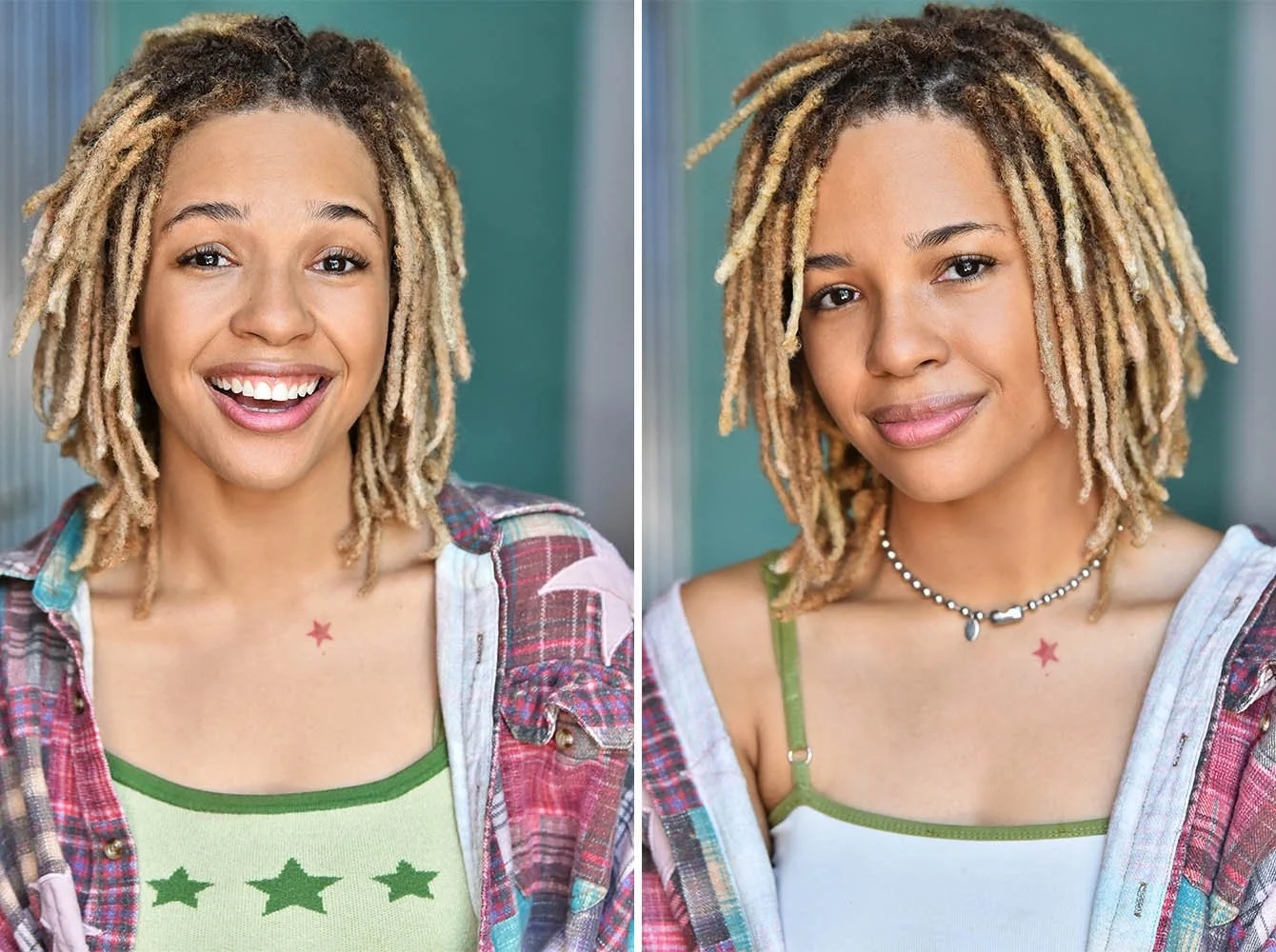
These two frames change more than expression; the tops differ too, so this is a whole-look comparison. Here's how I'd run it through the three questions. If we wanted her photo to communicate bright, outgoing energy, I'd choose the laugh. If we wanted something quieter and more understated, I'd choose the softer frame. Both expressions feel convincing to me, and both photos are technically strong. Neither is inherently the better choice. The purpose of the photo decides it.
Let's be honest, looking good matters to most people, but it works best as a tiebreaker, not the main reason. The strongest choice is usually the photo that best communicates what you want that particular look to convey.
No method can predict which photo will get you called in or booked. What this process can do is help you choose an image that communicates what you intended.
Outside eyes help too. Show your photos to a few people you trust and ask what each one communicates before you tell them what you intended. They won't all use the same word, and they don't need to. If you were going for confident and most people say guarded, that's worth knowing. Feedback is information, not a verdict.
If you have representation, talk to your agent about your photos. Actors sometimes dislike the shot their agent picks, and sometimes they have a point. But depending on how they work, your agent may see which roles you're being submitted for, hear feedback from casting, or have a strategy you aren't aware of yet. (It was my agent who chose to start using that fire-escape photo.) Understanding your agent's reasoning can help you make a more informed choice. If you're weighing how many looks to carry at once, How Many Headshots Does an Actor Need? goes deeper.
A commercial headshot doesn't have to be the friendliest photo, the most serious one, or even your personal favorite. It needs to communicate what you want it to, and you should know why you chose it.
Planning Your Commercial Headshots
If you’d like help figuring out what your commercial headshots should communicate, I talk it through with every actor before we shoot. Browse my actor headshot portfolio, see more of my work at Marc Cartwright Headshots, or contact me to book a session in Los Angeles.
As a contributing writer for Backstage, I also write about actor headshots and headshot photography. You can learn more about my background and approach, or browse the Actor Headshot Advice Library for more guides.